There’s a unique magic in writing a two-hander. Two characters, one space, and no distractions — just dialogue, subtext, and the emotional tightrope that binds them.
It’s the most intimate of theatrical forms, and also, in many ways, the most exposing. There’s nowhere to hide — for the writer or the characters.
I’ve always been drawn to that naked intensity. With just two voices in the room, you’re compelled to dig deeper into what drives them: their needs, flaws, secrets, and longings. A two-hander demands clarity of intention — every line must earn its place.
How to write a two-hander

Over the years, whether devising new material with actors or revisiting old scripts through workshops, I’ve come back to three key principles:
- Start with the tension, not the setting. What’s the core conflict between these two people? Why can’t they walk away? The stakes don’t need to be world-ending — but they do need to be personal and inescapable.
- Build a rhythm, not just a plot. With two voices, pacing becomes music. Moments of overlap, interruption, silence — these are dramatic beats, not filler. The scene breathes with them.
- Let opposites attract — or combust. Whether lovers, strangers, or adversaries, dynamic contrast fuels the drama. One character’s truth should always threaten the other’s.
Two-handers are a gift to actors and audiences alike. They invite us into the quiet storm of human relationships — the fragile, funny, furious dance we all recognise.
And for writers? They’re a masterclass in restraint and resonance.
Sustaining Tension Without Extra Characters

One of the great myths of playwriting is that tension comes from conflict between many. But in a two-hander, the pressure cooker is already sealed — what matters is how heat is applied.
So how do you keep the air charged without the safety valve of a third voice? Here are some of the techniques I return to again and again:
- Asymmetry of knowledge or power: Let one character know something the other doesn’t. Or give one of them leverage — moral, emotional, financial. Even love can be a weapon when it’s unevenly held.
- Tactical silence: A pause at the right moment can speak louder than pages of dialogue. In a two-hander, silence becomes its own kind of speech — charged with threat, hurt, or anticipation.
- Reversal of expectation: Shift the power dynamic mid-scene. Let the person who seemed composed crack, or the passive one lash out. It doesn’t have to be loud — even a quiet act of defiance can flip the axis of control.
- Time as pressure: Impose a deadline. A train that’s about to leave, a decision that can’t be deferred, a truth that must be confessed “before she wakes.” Time doesn’t need to shout; it just needs to tick.
- Repetition with variation: Return to the same argument, question, or moment — but let it land differently each time. As with Constellations, this can reveal what’s changed in them, even if the words are eerily similar.
- Emotional misalignment: Let them fall out of step. One wants closure, the other wants to reopen the wound. They might be sharing space — but they’re not sharing stakes. That gap is pure electricity.
These tools don’t require extra characters. In fact, they thrive on constraint. Two people, alone together — it’s all the ingredients you need for combustion.
Case Study 1: Lungs by Duncan Macmillan

Macmillan’s Lungs strips theatre to its bare bones — no set, no props, no scene changes — and yet it pulses with urgency.
A couple debates whether to have a child in a world on the brink of ecological collapse. The tension isn’t just ideological; it’s deeply emotional. Their conversations spiral, overlap, fracture — mimicking the breathless anxiety of modern life.
What’s remarkable is how the play sustains momentum through emotional oscillation. The characters swing between intimacy and alienation, humour and despair. The stakes are existential, but the delivery is raw and recognisable. Every pause, every interruption, becomes a battleground for control, vulnerability, and connection.
Time Catapulting and the Fluidity of Form in Lungs
One of Duncan Macmillan’s most distinctive dramaturgical tools in Lungs is his use of time catapulting — the rapid, unannounced shifts across time and space that propel the narrative forward without traditional markers like scene changes, lighting cues, or costume shifts.
In a conventional multi-character play, such transitions might feel jarring or demand logistical resets. But in a two-hander, especially one as stripped-back as Lungs, they become part of the play’s rhythm — almost like breath itself.
The Rhythm of Lungs
Macmillan’s script is composed of short, staccato scenes — sometimes just a few lines long — that leap days, months, even years in the blink of an eye.
There are no blackouts, no scene headings, no stage directions to signal the shift. Instead, the actors carry the transitions entirely through tone, rhythm, and emotional continuity.
This creates a sense of temporal vertigo — the audience is constantly catching up, recalibrating, leaning in.
How Lungs sustains its energy
What makes this work so effectively in a two-hander is the intimacy and immediacy of the form. With only two characters, the audience quickly tunes into their emotional frequencies.
We don’t need external cues to tell us we’ve moved forward in time — we feel it in the shift of a glance, the weight of a silence, the way a line lands differently than it would have five minutes earlier.
The minimalism of Lungs
In a larger cast, such rapid transitions might require logistical resets — new entrances, costume changes, lighting shifts — which can interrupt momentum.
But with two actors and a bare stage, Macmillan turns minimalism into propulsion. The absence of theatrical “furniture” becomes a feature, not a limitation.
How the fragmentation of text relates to character
This technique also mirrors the psychological experience of the characters. Their conversations are fragmented, recursive, emotionally volatile — and so is their sense of time.
Parenthood, climate anxiety, intimacy — these aren’t linear experiences. They loop, stutter, accelerate. Macmillan’s form reflects that beautifully.
Case Study 2: Constellations by Nick Payne

In contrast, Constellations plays with form as much as content. Payne uses the multiverse theory to replay key moments in a relationship between a physicist and a beekeeper — each time with a slight variation.
The piece uses repetition as a structural device. The repetition becomes revelatory in a profound way. We see how a single word, a different tone, can shift the entire trajectory of a life.
What keeps the tension alive is possibility. The audience is constantly recalibrating: which version is “real”? Which outcome do we want? The emotional stakes deepen as we realise that love, like quantum theory, is full of uncertainty — and that’s what makes it so achingly human.
The Big Things and the Time–Space Elasticity of Intimacy

In my own two-hander, The Big Things, I was interested in how love responds to pressure — particularly the strain a new child places on a couple already negotiating their emotional differences.
It’s a story about communication and miscommunication, about how the things that divide us are sometimes the very things that bind us.
The play unfolds not in one fixed setting but across a series of fluid locations — some domestic for intimacy, some public to heighten the tension, but all emotionally distinct ones. What ties them together isn’t geography, but the evolving tenor of the relationship.
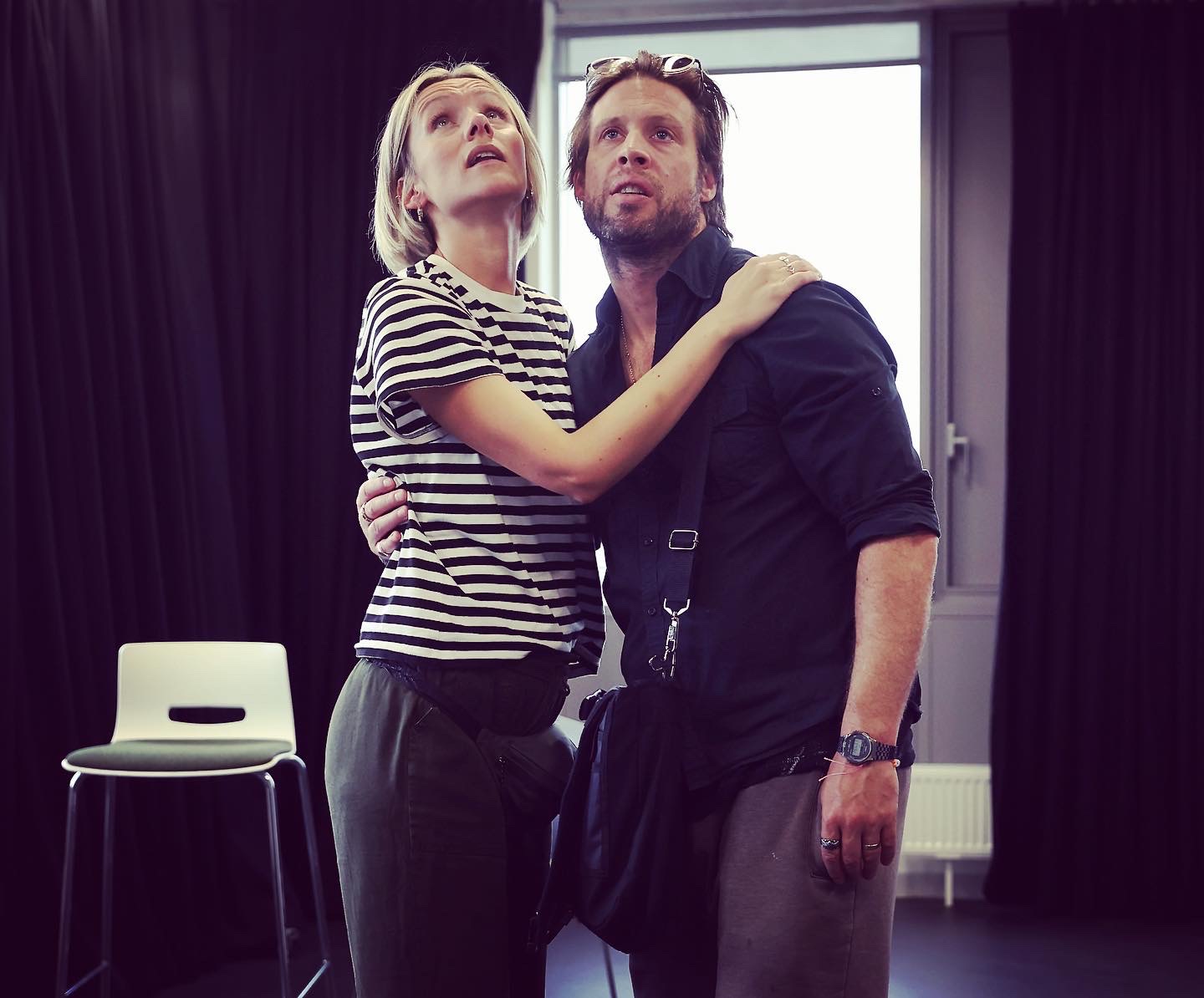
Rehearsing The Big Things

In rehearsal, we discovered that you don’t need to see a room change — you need to feel the emotional temperature shift.
The characters carry their history with them from space to space, and the audience follows not because they’ve been told where we are, but because they recognise how it feels.
The Big Things in production
This is one of the tricks with two-handers that move through space and time: physical staging becomes symbolic, and emotional logic takes the lead.
The effect is that The Big Things moves with a kind of dreamlike fluidity — not surreal, but intuitive. The audience never questions where they are, because they’re tethered to the couple’s inner weather. It’s a dramaturgy of resonance, not location.
And after sitting on the page dormant for almost a decade, we’re bringing The Big Things back to life at this year’s Greater Manchester Fringe Festival. Find out more about the rehearsals.
The Two-Handers

You might have guessed I’m pretty passionate about small-cast plays. I’ve written plays with up to 10 characters, but I tend to try to keep a cast small and intimate.
Check out some of my two-hander plays in my book The Two-Handers, including my two-hander Les & Ali’s Big Balearic Adventure, and some of my three-hander plays in The Three-Handers. Or for plays with larger casts, check out my book Plays One.
Come to the Greater Manchester Fringe!
The GMFringe is a brilliant festival, crammed full of new-writing and popular revivals.
Running all the way through July, it’s also a favourite warm-up opportunity for plays and stand-ups to test their new work in front of audiences before they take it to the Edinburgh Fringe in August.
So, see it first in Manchester! Get your tickets for The Big Things at the Kings Arms Theatre, 16th, 17th, and 23rd July.
Thanks for reading!


Leave a Reply