It started with watching the telly. Many things do.
My friend Martin Jameson frequently begins our conversations with ‘Have you seen………?’ and, invariably, the answer is no. So when he asked me if I’d seen the HBO series The Vietnam War, written by Ken Burns, the answer was a typical ‘no’. So I watched it.
It was not an easy watch. The series was made in 2017, and I watched it two years later. It has 10 parts and involves many interviewees. What’s particularly impressive is the scale of the project. This is not a series that confines itself to the viewpoint of one particular group over another. Consequently, we hear from everyone: North Vietnamese, South Vietnamese, US veterans who became disillusioned with the war, veterans who still feel it was a just war, conscientious objectors, etc, etc. I ‘binge watched’ the whole series – bearing in mind that each episode is over an hour long (some nearer to two hours), this was quite an undertaking. At the end of the last episode, I remember distinctly saying aloud, “There’s a play in there.”

This was not some magical visionary experience – it was a hope rather than a prediction. So the next thing I did was to watch the whole bloody lot again with a notebook in front of me. I filled the notebook.
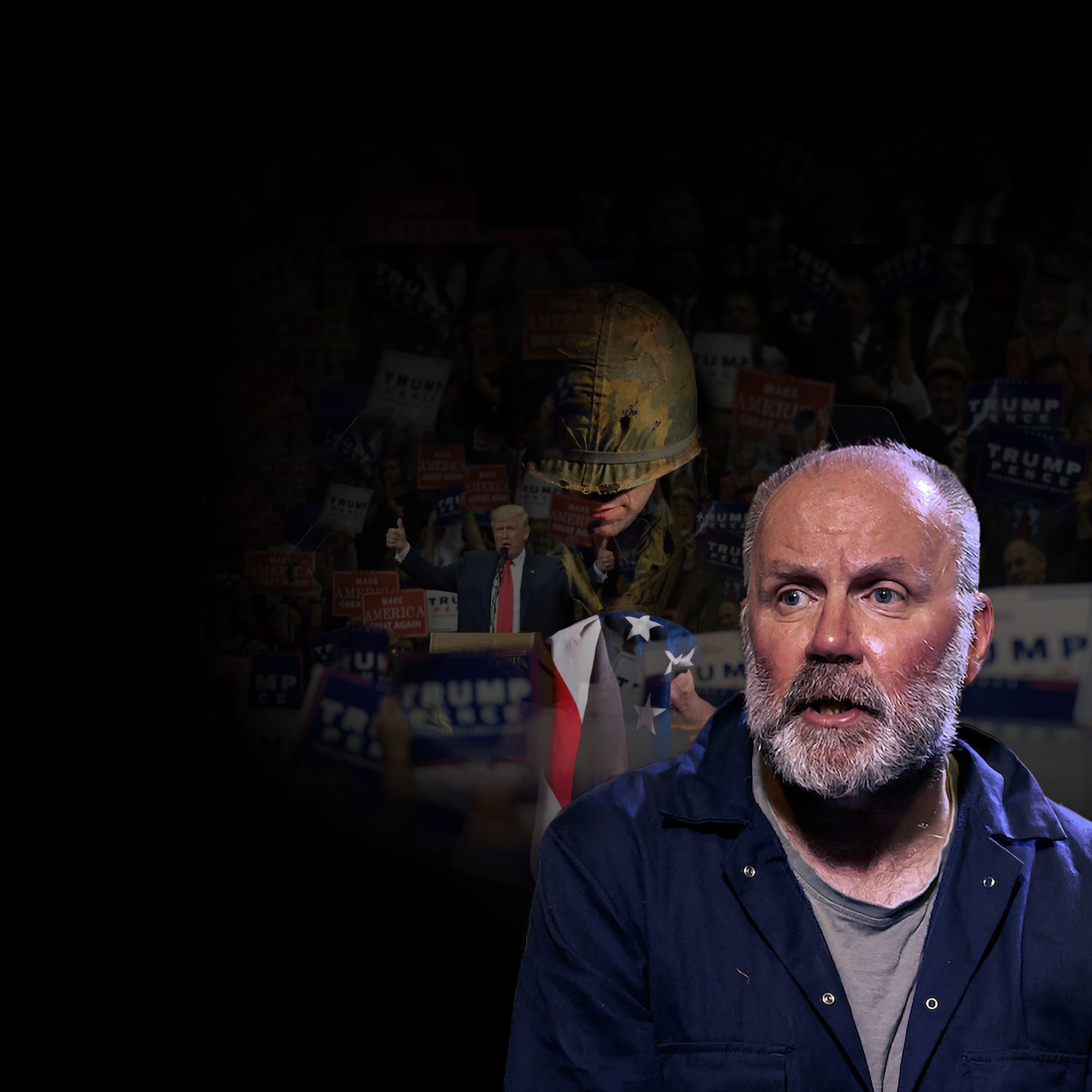
The reason I thought there was a play in there was not because I wanted to write a play detailing one man’s war stories. What struck me was the sense of abandonment and isolation that the US veterans who had served in Vietnam still felt half a century later. It wasn’t that they had been angry – they still were angry – blazing angry. Angry at having been lied to, angry at having been let down, angry at having been made to feel like criminals when they came home; angry at the complete lack of care or rehabilitation or aftercare. Their stories were harrowing, and I was struck by how much of a working-class man’s war it was. It was pretty easy to defer if you were going to college, university, or you had – ahem – bone spurs! But that anger – visceral, real and undiluted – was something we saw in the MAGA movement. However incoherent or politically unengaged, people felt pain and resentment towards the politicians in whom they’d placed their trust for so long.
There were echoes of that anger in this country, too. I come from North Lincolnshire – a 70% Brexit voting area. The bitter debate that still rages is characterised as much as anything by one side calling the other stupid. I tend to find – as a former teacher – that if you want someone to understand your side of the argument, it is probably better to respect your opponent and not call them names. But populism has destroyed the noble art of disagreeing respectfully. Not everyone who voted for Brexit or for Trump is a racist or is stupid or is an advocate for political violence. Undoubtedly, some are, and that makes for difficult political discourse. But there are those on my side of the argument – the liberal left, if you will – who dismiss the anger and resentment of those whose life experience they don’t share, understand or care about.

Gradually, a character began to emerge – born and brought up in the Rust Belt. I decided to make Jimmy Vandenberg a Ford car worker because Robert McNamara, the President of Ford Motor Company in the 1960s, became Lyndon Johnson’s Secretary of Defence and was a key player in America’s prosecution of the Vietnam War. It was he who reported to the President as early as 1965 that the war could not possibly be won, yet they still sent 58000 young American men to their deaths. It was a loose connection, and no mention of it is made in the play, but I liked the dramatic irony of a Ford car worker following his CEO into the war as a frontline soldier rather than as a politician. Jimmy is a bit ‘rough and ready’; he’s a good mechanic, but he’s not always polite, subtle or sensitive. In the words of Arthur Miller, however, he is ‘himself purely’.
The first iteration of the play – Leaving Vietnam – was first performed in the Kings Arms, Salford, at the start of September 2021 as part of the Manchester GM Fringe. It was not a promising start. There were four reviewers in the audience: one refused to review it on account of believing it to promote the Americans as heroes when ‘the other side were equally massacred’ (for information the US lost 58,000 troops the North Vietnamese approximately one and a half million. There was nothing equal about it at all), another regarded it as a war criminal railing against the world for an hour because it wasn’t paying him enough attention and a third declared it to be out of date and past its time. The play had not featured in any press releases from the GM Fringe, and the Awards adjudicators didn’t send anyone to see it. Only Dave Cunnigham from British Theatre Guide wrote a review which offered encouragement. However, the audience (still socially distanced in the Autumn of 2021) told a different story. Quite genuinely, if it hadn’t been for people like Mike Heath, Martin Jameson, David and Rosie Fleeshman, Rob Johnston and many others offering full-throated support, I might have given up.

I spent some time revising the script and put it on again at Hull Truck’s Grow Festival with better results, and then came the big one – Edinburgh 2022. The Fringe was still recovering from the Pandemic, and ticket sales were down 27% compared to 2019. However, the show got a following and – in particular – I was moved by the response of Vietnam veterans, visiting from the US. The show garnered mostly 4 and 5-star reviews (The Scotsman being an exception), but the audiences responded very warmly to it.
The following year, we put the show on in London at The Park Theatre. It started slowly! But after 4 weeks, we were coming close to selling out, and again, the response from audiences was very warm. But both Andy Jordan and I still felt that the potential of the show had yet to be realised. By 2024, Trump was on the march again, and whether he was going to win in November or not, the phenomenon of MAGA had not gone away. The revisions to the script meant that more emphasis was placed on what happened to Jimmy after he came home and his gradual seduction by the MAGA message, and I reduced the number of ‘war stories’, which were important but perhaps too many in number. This time, the play sold out in Edinburgh and made ‘Pick of the Fringe’. The reviews were uniformly excellent, and I thought the job was done.
Except that Trump went and won! So, on the basis that something good had to come out of an appalling political tragedy, we decided to rewrite the ending and see if anyone wanted the show in their venues. Consequently, you find me writing this somewhat hastily scribbled journal in the middle of the Autumn tour and the day before we bring the show to The Edge Theatre in Chorlton.
Born in the USA is more a human play than a political one, although it involves a political discourse. Jimmy is wrong about many things, and I vehemently disagree with him. But he’s a man damaged by experience and struggling to understand a world that he perceives has left him behind. You may not like all he says, you may not like him, but I think he deserves our sympathy and possibly our respect.
I’d love to see you if you can get to The Edge on Thursday or Friday this week.
Thanks
Richard


Leave a Reply